By Staff Writer.@
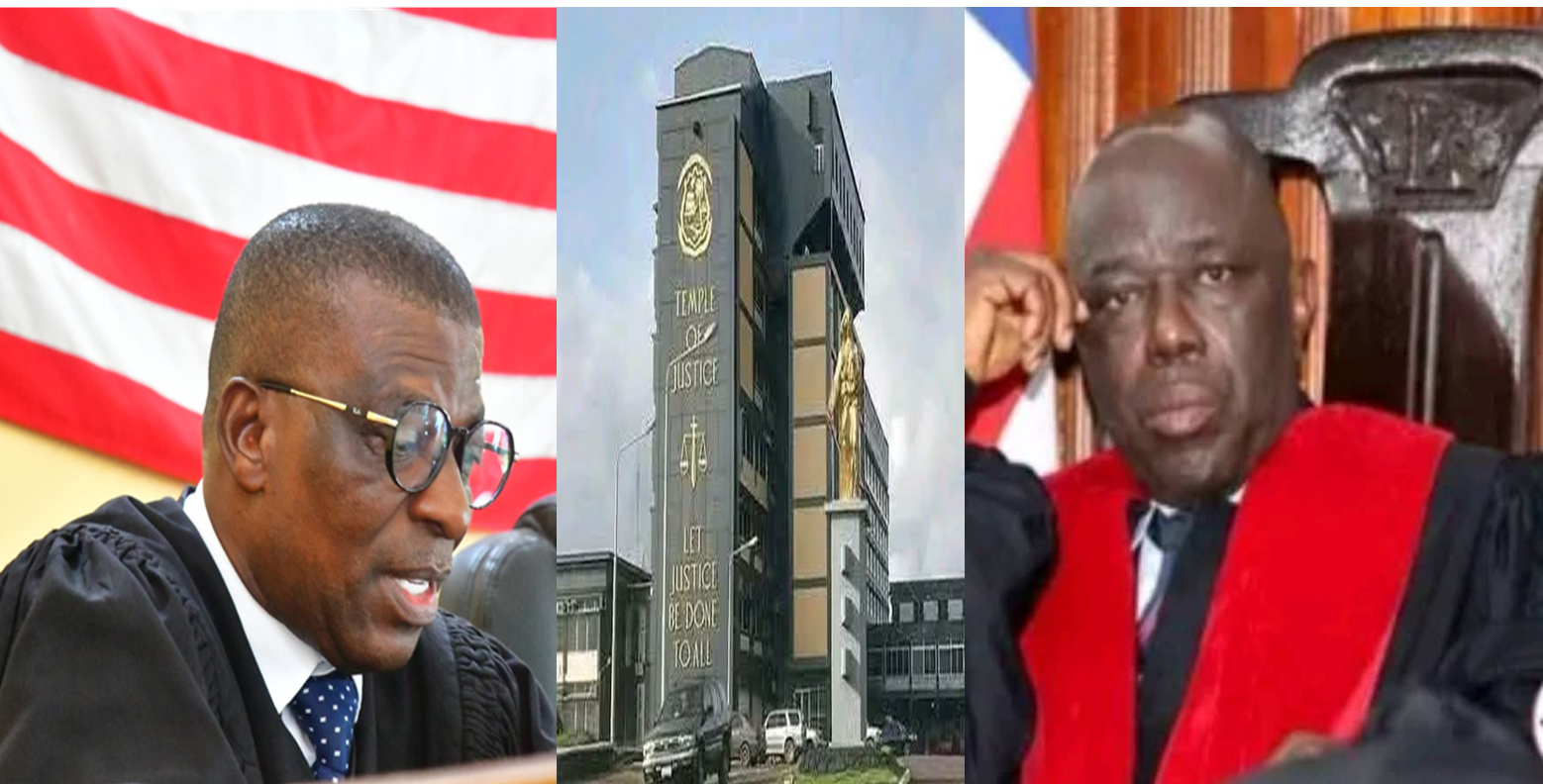
Monrovia – What began as a routine opening of court in southeastern Liberia became one of the sharpest judicial rebukes yet of the Boakai administration — and of the head of the Judiciary himself.
Delivering the opening charge for the 7th Judicial Circuit Court, on Monday, Assigned Judge J. Kennedy Peabody chose a theme that left little room for polite evasion:
“WHEN PUBLIC OFFICE BECOMES PRIVATE PROPERTY: THE CORRUPTION OF POWER, THE BETRAYAL OF PUBLIC TRUST, AND THE DANGER OF TRIBAL FAVORITISM TO LIBERIA’S DEMOCRACY”
It was not an abstract lecture. It was a direct intervention in the national controversy over Chief Justice Yamie Quiqui Gbeisay’s admission that he recommended his own son for a judicial appointment — and his insistence that he had done nothing legally or ethically wrong.
On September 18, 2025, President Joseph N. Boakai nominated several individuals to fill vacancies in the judiciary, including Willeyon Gbeisay, son of the Chief Justice, to serve as Associate Magistrate at the Paynesville Magisterial Court.
Under intense public criticism, Chief Justice Gbeisay acknowledged that his son’s nomination was triggered by a recommendation he made, but denied that it constituted a legal or ethical breach.
The pressure did not subside. On October 1, 2025, the Executive Mansion confirmed that Willeyon Gbeisay had stepped down as Associate Magistrate-Designate, and that President Boakai had accepted his decision to withdraw.
The resignation ended the appointment. It did not end the question.
That question — whether power in Liberia is being exercised as a public trust or hoarded as private property — is what Judge Peabody took up in Grand Gedeh.
“There comes a time in the life of every nation when silence in the face of injustice becomes dangerous,” Peabody told the assembled lawyers, magistrates, county officials and citizens.
“When the abuse of authority becomes normalized, and when those who should protect the public interest begin to confuse their personal interests with the interests of the State.”
He continued: “There comes a time when public officials must be reminded that their offices do not belong to them. There comes a time when leaders must be reminded that power is not ownership, authority is not superiority, and appointment to public office does not confer a license to humiliate, intimidate, discriminate against, or oppress fellow citizens.”
And then, in a line widely understood as aimed at those who loudly condemn corruption while practicing favoritism behind closed doors:
“And there comes a time when those who loudly condemn corruption must be invited to examine whether corruption has already found a comfortable home in their own conduct.”
According to him, that time is now.
A constitutional argument, not just a moral one
Peabody anchored his charge not in rhetoric alone, but in the Constitution of Liberia.
*Article 1* declares: “All power is inherent in the people. All free governments are instituted by their authority and for their benefit.”
From that principle, he argued, flows a decisive legal consequence: no public officer is the owner of governmental authority. Every public officer is a temporary custodian of authority entrusted by the sovereign people. The institution remains the property of the Republic.
“Public office is a sacred trust, not personal property,” he said. “The Republic of Liberia belongs to all Liberians. It does not belong exclusively to any one person, or head of a government institution. It does not belong to any single family, village, county, tribe, political party, religious organization, or circle of friends.”
Government and its institutions, he stressed, are established to serve the people — not to provide a private inheritance for those temporarily entrusted with public responsibilities.
That reading is reinforced by *Article 5(c)* of the Constitution, which requires the Republic to “take steps, by appropriate legislation and executive orders, to eliminate sectionalism and tribalism, and such abuses of power as the misuse of government resources, nepotism and all other corrupt practices.”
In other words, Peabody argued, nepotism is not merely bad manners. In Liberia’s constitutional order, it is a named abuse the State is commanded to eliminate.
### The law on nepotism: where the Chief Justice’s defense collides with the Code
The Chief Justice’s public defense has rested on a narrow legal claim: that no specific law bars the President from appointing a non-lawyer as Associate Magistrate, and that the appointment power itself belongs to the President under the New Judiciary Law, Title 17, Section 7.5.
Critics, including the Center for Transparency and Accountability in Liberia (CENTAL), have pointed to a different law: the *National Code of Conduct for All Public Officials and Employees (2014)*.
CENTAL has argued that Section 1.3.16 defines nepotism as when a public official “appoints, employs, promotes, or recommends for advancement family members in any agency or branch of government in which he or she works.”
Section 1.3.12 defines family members to include biological or adopted children of public officials, while Section 9.8 provides penalties including reprimand, suspension, demotion, or removal.
That distinction is politically explosive.
The Chief Justice says: I did not appoint him; the President did.
The Code says: recommending a family member for advancement in your own branch can itself be nepotism.
Peabody did not name a statute in his charge. He made the broader jurisprudential point that legality cannot be reduced to a technical loophole:
> “It is not inherently unlawful for relatives of public officials, or people from the same county or ethnic community, to be employed in the same government institution. The wrong arises when kinship, tribal identity, friendship, or personal association replaces merit, lawful recruitment procedures, and equal opportunity.”
“The wrong arises when qualified Liberians are deliberately excluded because they do not belong to the favored family, village, county, or ethnic community. The wrong arises when an official manipulates recruitment, promotion, placement, or disciplinary procedures to confer unjustified advantages upon associates.”
In that framing, the issue is not whether Willeyon Gbeisay was qualified on paper. It is whether the process was captured — whether the recommendation came from the very head of the institution that would supervise, discipline, promote, and evaluate the appointee.
### The anatomy of a captured institution
Peabody offered what amounted to a diagnostic checklist for how public institutions are privatized from within:
> “Brother is employed. A son is employed. A nephew is employed. A cousin is employed. The brother of a spouse is employed. A close friend is employed. Individuals from the leader’s hometown and county are employed. And gradually, recruitment becomes less a question of competence and more a question of personal connection.”
“The question is no longer: Who is best qualified to perform this public duty? Instead, it becomes: Whose relative is this applicant? Who recommended this person? From which village or county does this person come?”
He then posed the questions that go to the heart of equal citizenship:
What then becomes of the citizen from another county who possesses the required competence but is excluded because the leadership prefers members of its own community or county?
What becomes of the public employee who has served faithfully for twenty years but watches a less-qualified relative of the institution’s head receive promotion?
“These questions go directly to the meaning of equal citizenship,” Peabody said.
He described a pattern he said is now disturbingly familiar in Liberian public administration: officials who conduct themselves as though appointment has transferred ownership of an entire institution to them.
“They treat employment opportunities as family privileges. They treat promotions as rewards for personal loyalty. They treat transfers as instruments of punishment. They treat subordinates as servants rather than public employees entitled to dignity and respect.”
“A public institution is not the private estate of its director or head. It is not the ancestral inheritance of its head. It is not the family business of its administrator. It is an institution of the Republic, established and maintained for the benefit of the Liberian people.”
A public official may exercise administrative authority, he added, but that authority must remain subject to the Constitution, statutory law, institutional regulations, and the requirements of fairness.
### Why the Judiciary cannot afford this fight
Politically, the stakes are higher because the controversy sits inside the Judiciary itself.
The Chief Justice is not an ordinary minister. He is the head of the branch constitutionally charged with checking abuse of power, interpreting the Code of Conduct, and disciplining judges and magistrates. When the head of that branch publicly defends recommending his son into that same branch, critics say, it creates both a conflict of interest and a crisis of moral authority.
CENTAL has called on the 55th Legislature to implement sanctions against the Chief Justice, arguing that the resignation of his son does not settle the matter.
Supporters of the Chief Justice counter that the President’s appointment power is discretionary, that magistrates need not be lawyers, and that attacking the son punishes a young Liberian for his father’s name.
Peabody’s speech implicitly rejected that framing. The danger, he argued, is systemic, not personal:
“Where nepotism becomes institutional practice, meritocracy suffers. Where meritocracy suffers, institutional competence declines. Where competence declines, public services deteriorate. Where public services deteriorate, citizens lose confidence in the institution. And where citizens lose confidence in institutions, democratic legitimacy is weakened.”
“Can nepotism and tribal favoritism sustain democracy?” he asked. “Or can a democracy survive when access to public opportunities increasingly depends upon personal connections rather than citizenship, qualification, and merit?”
A warning to Grand Gedeh — and to Monrovia
That the charge was delivered in Grand Gedeh matters.
Grand Gedeh, like every county, has felt the long shadow of Liberia’s history of sectionalism — of governments perceived as ruling for one group, one county, one circle, rather than for the whole Republic. Peabody’s insistence that Liberia “does not belong to any single family, village, county, tribe” resonated precisely because tribal favoritism is not an abstraction in the southeast. It is lived experience in hiring, in promotions, in transfers, in who gets heard and who gets ignored.
But the speech was also clearly addressed beyond the courtroom in Zwedru — to Monrovia, to the Executive Mansion, to the Temple of Justice, and to every head of a ministry, agency, commission, and court who has confused stewardship with ownership.
“A nation cannot defeat corruption when those who condemn it publicly practice favoritism, nepotism, tribal exclusion, and abuse of authority privately,” Peabody said.
In that single sentence, he collapsed the distance between grand anti-corruption slogans and daily administrative practice. Corruption, in his definition, is not only the theft of money. It is the theft of opportunity. It is the conversion of a public trust into a private network.
Legally, three questions now remain unresolved:
1. Will the Legislature act?** CENTAL’s call for sanctions has put the matter before the 55th Legislature, but no formal sanction had been announced as of the opening of court.
2. Will the Judiciary police itself?** The Judiciary’s own ethics machinery will be tested by whether it can credibly investigate conduct by its own Chief Justice — the very official who presides over that machinery.
3. Will the Presidency reform the process?** The controversy has renewed calls for transparent, competitive, and published criteria for magisterial appointments, so that recommendations — from anyone, including the Chief Justice — are subject to independent vetting and public scrutiny.
For now, Willeyon Gbeisay’s resignation has removed the immediate flashpoint. It has not removed the precedent.
Judge Peabody closed his charge with a reminder that was both constitutional and moral: power is temporary, but the Republic endures.
Public officials, he said, must be reminded again and again that they do not own the offices they occupy. They hold them — briefly, conditionally, and on behalf of all Liberians.
If Liberia forgets that distinction, he warned, it will not lose democracy in a single dramatic coup. It will lose it slowly — one relative hired, one qualified citizen excluded, one transfer used as punishment, one institution turned into a family estate at a time.